
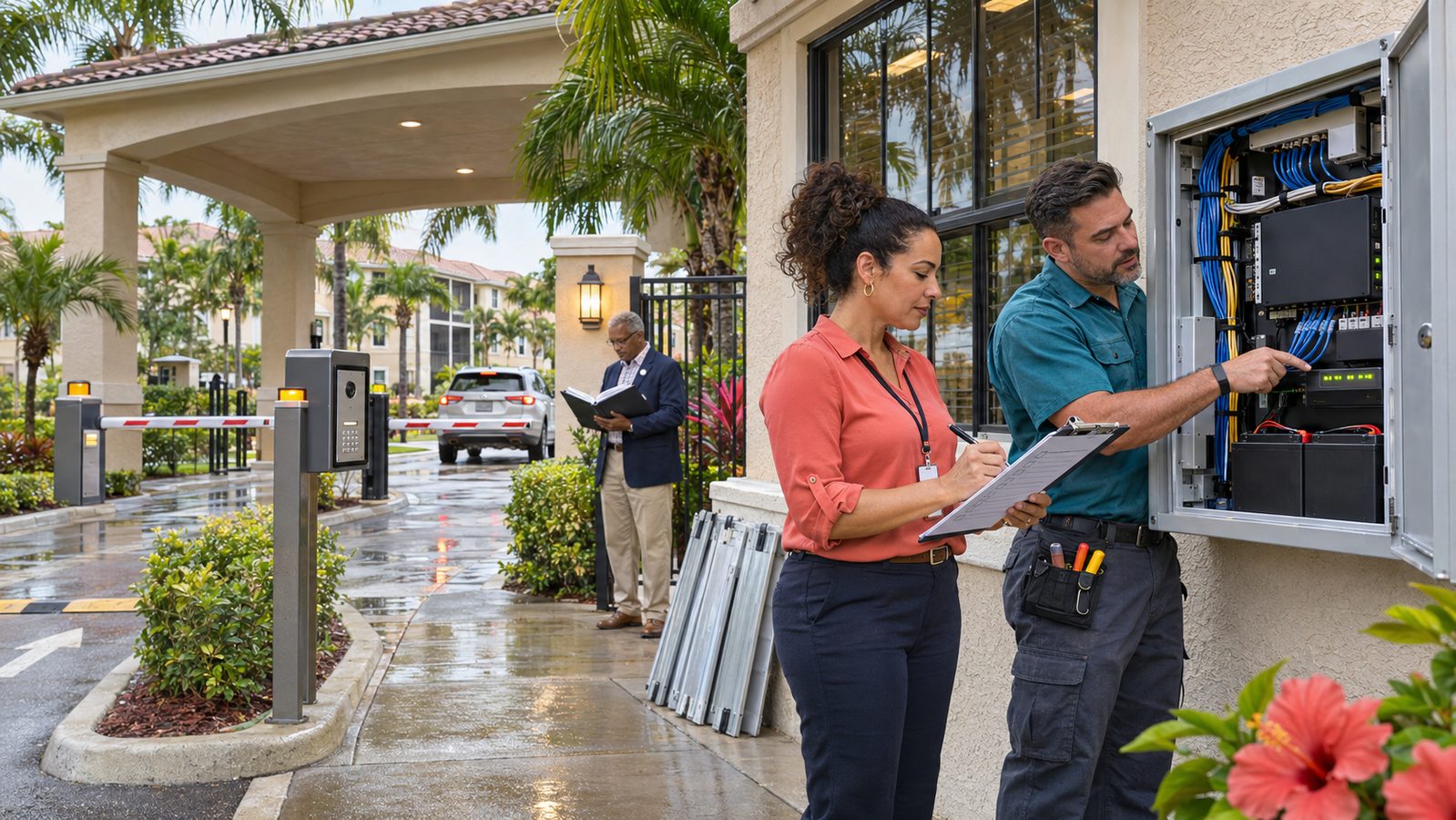
<p>Central Florida community associations and their management firms sit at the intersection of resident information, assessment payments, vendor invoices, property access, meeting records, and physical operations. That combination makes cybersecurity a board-level operational issue—not simply an IT purchase.</p>
<p>The Florida Department of Business and Professional Regulation explains that community association managers may control or disburse association funds, prepare budgets and other financial documents, help conduct meetings, coordinate maintenance, and perform day-to-day management. Each of those workflows depends on trusted identities, accurate records, and available systems.</p>
<p>This article provides general cybersecurity planning information, not legal, regulatory, insurance, fiduciary, or professional advice. Associations and management firms should determine their obligations with qualified Florida counsel and other appropriate advisors using current statutes, governing documents, contracts, insurance terms, and facts.</p>
<h2>Map the association's digital operating environment</h2>
<p>Begin with an inventory that covers more than office computers. Identify every system, account, vendor, device, and information flow used to operate the community:</p>
<ul>
<li>Resident portals, owner rosters, tenant records, violation records, architectural applications, and meeting materials.</li>
<li>Accounting platforms, bank access, lockbox services, assessment payments, card processing, and reserve-fund reporting.</li>
<li>Email, cloud storage, document management, e-signature, websites, newsletters, and mass-notification tools.</li>
<li>Gate controllers, visitor systems, cameras, intercoms, key-fob systems, pool access, elevators, building automation, and environmental controls.</li>
<li>Management-company systems, legal and accounting portals, maintenance platforms, remote-support tools, and vendor accounts.</li>
<li>Office workstations, laptops, mobile devices, scanners, copiers, removable media, network equipment, and backups.</li>
</ul>
<p>For each item, record the business owner, technical owner, administrator, data handled, vendor support path, authentication method, backup dependency, contract renewal date, and shutdown or recovery procedure.</p>
<h2>Protect resident and owner information</h2>
<p>Florida Statute 501.171 states that covered entities must take reasonable measures to protect electronic data containing personal information. It also addresses breach notice, third-party agents, and disposal of customer records. Whether and how a specific association or management firm is covered should be evaluated with counsel.</p>
<p>The safest starting point is data minimization. Keep only information that has a defined operational, legal, or recordkeeping purpose. Document where it resides and who needs it. Separate public or owner-inspection records from restricted identity, banking, credential, personnel, and security information.</p>
<p>Use approved secure portals for sensitive documents rather than ordinary email attachments. Encrypt managed laptops and supported mobile devices. Lock paper files, secure scanners and copiers, and use a documented destruction process. The FTC recommends understanding how personal information moves through the organization, limiting access, training personnel, and verifying service-provider safeguards.</p>
<h2>Make payment changes resistant to impersonation</h2>
<p>The FBI describes business email compromise as one of the most financially damaging online crimes. A common scenario is a message that appears to come from a familiar vendor but supplies new payment instructions. Community associations regularly pay landscapers, roofers, engineers, construction firms, insurance providers, utilities, attorneys, and emergency contractors, so the workflow deserves specific controls.</p>
<p>Adopt a written payment-change procedure:</p>
<ol>
<li>Never accept new banking instructions solely through email, text, or a document attached to a message.</li>
<li>Call a previously verified contact using a number already in the vendor record—not a number supplied in the change request.</li>
<li>Require approval by two authorized people for new payees, bank-detail changes, wires, and high-value payments.</li>
<li>Record who requested, verified, approved, and released the payment.</li>
<li>Alert the bank and insurer immediately if a fraudulent transfer is suspected; preserve the message and report the crime through the appropriate channels.</li>
</ol>
<p>Apply the same independent verification to requests that appear to come from a board member, manager, attorney, insurer, or emergency contractor.</p>
<h2>Strengthen identities and administrator access</h2>
<p>Use a unique account for every employee, board member, contractor, and administrator. Do not share a manager login or recycle a departing board member's account. Require multifactor authentication for email, banking, portals, cloud storage, remote support, and administrative access.</p>
<p>CISA recommends phishing-resistant MFA where possible. FIDO security keys and passkeys can prevent many attacks that capture passwords and one-time codes. Begin with the highest-risk users: email administrators, finance personnel, managers, board officers, remote-support providers, and anyone who can change access or payment settings.</p>
<p>Maintain an access matrix showing which roles can view resident information, release payments, change vendors, administer property systems, export records, or create users. Review it after elections, management transitions, employee changes, and vendor turnover. Disable access promptly, revoke active sessions, recover equipment and keys, and change shared device codes when someone leaves.</p>
<h2>Separate property technology from office technology</h2>
<p>Gate, camera, building-control, access, and life-safety-adjacent systems may have different support cycles and vendor requirements than ordinary business systems. Inventory them separately and document the operational impact if each becomes unavailable.</p>
<ul>
<li>Place property systems on appropriately segmented networks rather than the same network used for office browsing and guest Wi-Fi.</li>
<li>Remove unnecessary internet exposure and change default credentials before deployment.</li>
<li>Require named vendor accounts, MFA where supported, limited access windows, and logging for remote maintenance.</li>
<li>Track firmware, supported versions, replacement dates, and configuration backups.</li>
<li>Preserve safe manual procedures for gates, resident communication, visitor handling, and priority building operations.</li>
</ul>
<p>Security measures must not interfere with applicable safety requirements. Coordinate changes with qualified property, engineering, life-safety, and legal professionals.</p>
<h2>Put service-provider responsibilities in writing</h2>
<p>An association may outsource management, accounting, IT, access control, payment processing, legal work, websites, records, and maintenance coordination, but outsourcing a function does not eliminate operational risk.</p>
<p>For providers that handle sensitive information or administer systems, contracts and review procedures should address:</p>
<ul>
<li>Permitted use and retention of association information.</li>
<li>Named administrative access, MFA, logging, and subcontractors.</li>
<li>Security updates, vulnerability handling, backups, and recovery.</li>
<li>Incident notification timelines and cooperation.</li>
<li>Return, export, and secure deletion of records at termination.</li>
<li>Transition assistance, account ownership, and documentation.</li>
</ul>
<p>Verify important safeguards periodically. Do not rely only on a proposal, checkbox, or verbal assurance.</p>
<h2>Build hurricane and cyber continuity together</h2>
<p>Central Florida associations already plan for severe weather, power loss, building access, water intrusion, vendor mobilization, and resident communication. Cyber incident response should connect to that same continuity structure.</p>
<p>Document how the association will operate if email, the resident portal, management platform, payment system, gate network, or office becomes unavailable. Maintain protected offline or independently accessible copies of critical contacts, insurance information, bank escalation paths, system inventories, vendor details, and decision authority.</p>
<p>Back up critical records and configuration data using credentials and retention that ordinary ransomware activity cannot easily defeat. Test representative restores and obtain validation from the people who use the records. CISA advises organizations to plan and drill cyber incidents as they would other emergencies, with defined roles, communications, response procedures, and recovery responsibilities.</p>
<h2>Prepare for a data or account compromise</h2>
<p>A usable incident plan should answer:</p>
<ul>
<li>Who can isolate a device, disable an account, or suspend remote access?</li>
<li>Who contacts the management firm, board, IT provider, bank, insurer, counsel, and law enforcement?</li>
<li>Where are logs, affected messages, payment records, and system images preserved?</li>
<li>How will residents and vendors receive trustworthy updates if email is compromised?</li>
<li>Who evaluates Florida and other notification duties?</li>
<li>How will critical property operations continue during investigation and recovery?</li>
</ul>
<p>Florida's breach statute includes defined notice timelines and third-party-agent provisions. Do not wait for an incident to identify counsel, insurer contacts, forensic support, decision makers, and communication alternatives.</p>
<h2>A 30-day improvement plan</h2>
<ol>
<li><strong>Week 1:</strong> inventory data, systems, vendors, administrators, property technology, and critical operations.</li>
<li><strong>Week 2:</strong> enable MFA, remove stale accounts, document payment verification, and confirm account ownership.</li>
<li><strong>Week 3:</strong> review network separation, remote vendor access, backups, contracts, and record retention.</li>
<li><strong>Week 4:</strong> test a fraudulent payment request, account shutdown, resident communication fallback, and restoration of a critical record set.</li>
</ol>
<h2>Questions boards should ask management and technology providers</h2>
<ul>
<li>Which systems contain resident personal or financial information?</li>
<li>Can every privileged action be tied to a named individual?</li>
<li>How are vendor payment changes independently verified?</li>
<li>Which outside providers can remotely administer association systems?</li>
<li>When was the last successful restore tested by a business user?</li>
<li>What happens to accounts, records, domains, and configurations if a provider changes?</li>
<li>How will the community operate during simultaneous storm and cyber disruption?</li>
</ul>
<p>GebhardCS can help Central Florida community associations and management firms inventory systems, protect Microsoft 365 and endpoints, review remote vendor access, secure backups, document continuity, and test incident procedures alongside the association's legal, insurance, property, and management advisors.</p>