
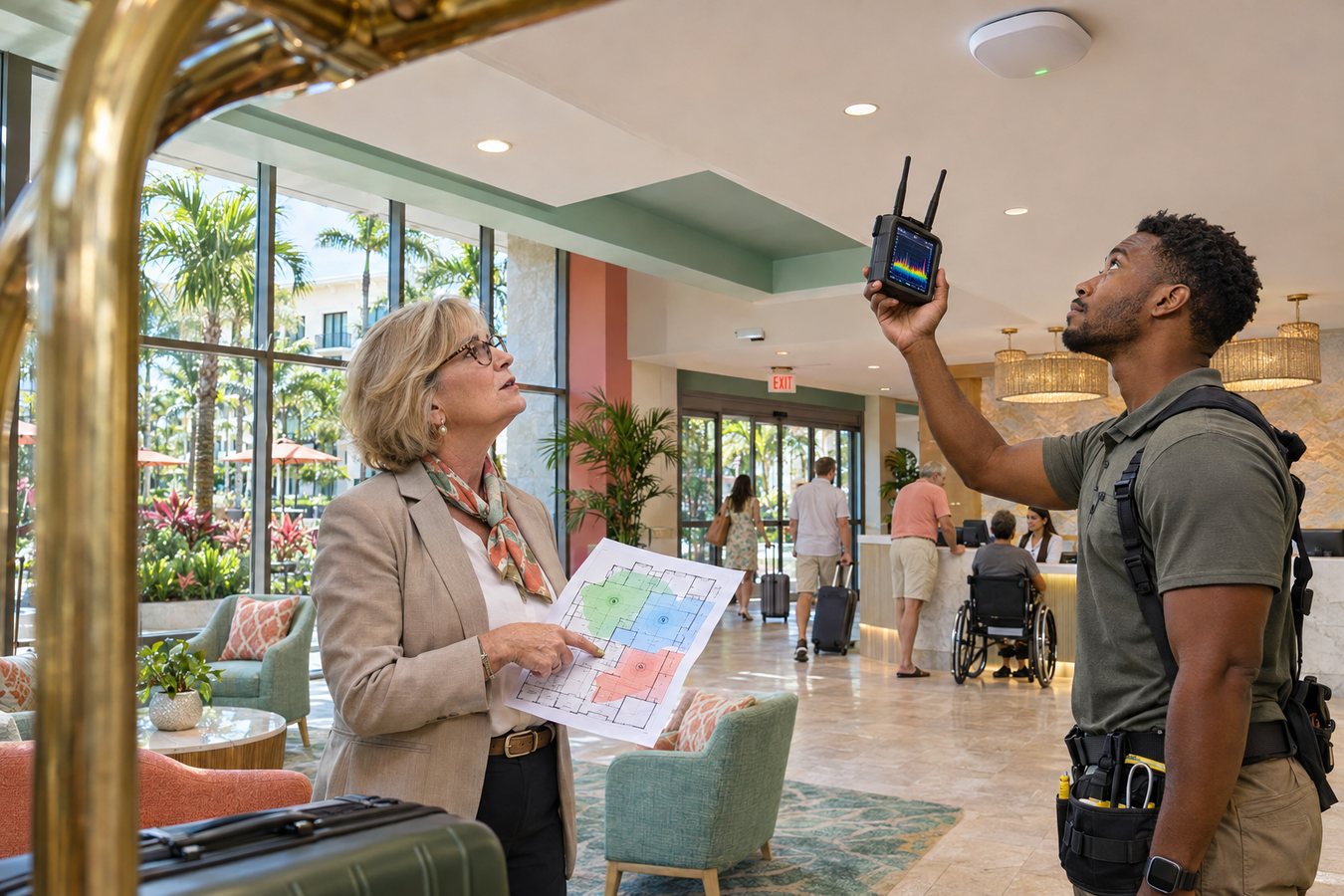
A hotel is a connected operating environment, not just a collection of guest rooms
A modern hotel may connect online reservations, a property-management system (PMS), payment terminals, point-of-sale systems, guest Wi‑Fi, door locks, cameras, phones, televisions, energy controls, digital signage, accounting, loyalty platforms, and remote vendors. A weakness in one relationship can affect guest privacy, revenue, physical operations, and the ability to check guests in or out.
NIST describes the PMS as an operations hub that can interface with point-of-sale systems, locks, Wi‑Fi networks, and other guest services. That makes the PMS important, but it should not become an unrestricted bridge between every system. The Federal Trade Commission recommends separating public Wi‑Fi from the business network, limiting vendor access, maintaining inventories, using multifactor authentication, updating systems, backing up data, and preparing incident-response and continuity plans.
For Central Florida properties, the challenge includes unusually high occupancy periods, seasonal workers, many third-party services, large numbers of personal devices, and hurricane-related disruption. Security must support hospitality rather than interfere with it. The practical goal is to keep public access convenient while placing strong boundaries around hotel operations and sensitive data.
This guide is general. Payment-card, privacy, franchise, insurance, contractual, and regulatory requirements depend on the property and its relationships. Confirm current PCI Security Standards Council materials and obligations with the organizations managing the hotel’s compliance program.
Map the hotel’s technology before trying to secure it
Start with an inventory organized by business function and trust level. Include:
- Property-management and central reservation systems.
- Booking engine, website, channel manager, and online travel agency connections.
- Front-desk, restaurant, bar, spa, gift-shop, parking, and other payment systems.
- Guest, employee, administrative, building, and vendor networks.
- Door locks, key encoders, elevators, cameras, alarms, access control, and emergency systems.
- Voice, messaging, email, digital signage, televisions, casting, and conference technology.
- Energy, lighting, HVAC, pool, laundry, kitchen, and maintenance systems that connect to a network.
- Servers, workstations, tablets, phones, printers, kiosks, and handheld devices.
- Cloud services, mobile applications, interfaces, APIs, databases, certificates, and domains.
- Vendors, franchise systems, remote support tools, service accounts, and administrator access.
For each item, record its owner, purpose, location, vendor, model or version, support status, data handled, network segment, criticality, backup method, remote-access path, and recovery procedure. Reconcile the inventory after renovations, new amenities, vendor changes, and seasonal deployments.
An unknown device connected behind a television or inside a mechanical room still belongs in the risk picture.
Separate guest access from hotel operations
Guest Wi‑Fi should be treated as an untrusted public service. FTC guidance advises businesses that offer customer Wi‑Fi to keep it separate from the business network. A hotel design should go further by defining distinct zones based on purpose and risk.
A property may need separate segments for:
- Guest internet access.
- Hotel employee devices.
- Front-desk and administrative operations.
- Payment-card systems.
- Property-management and reservation services.
- Building and internet-connected devices.
- Cameras and physical access systems.
- Voice and conference systems.
- Backup and management infrastructure.
- Vendor access and temporary event equipment.
Segmentation is not merely creating several Wi‑Fi names. Enforce traffic rules between segments, restrict administration, monitor boundaries, and test that a device on the guest network cannot reach hotel operations. Use client isolation on guest networks where appropriate, secure network equipment, change default credentials, patch firmware, and protect configuration backups.
Document exceptions. A printer, casting device, conference system, or vendor gateway should not become an unreviewed path around the design.
Treat the PMS as a high-impact system
The PMS may contain or connect to reservation details, contact information, room assignments, payment references, preferences, and operational records. Protect it according to business impact:
- Require unique accounts rather than shared front-desk credentials.
- Use strong multifactor authentication for administrators and remote access where supported.
- Assign roles so employees see only what their duties require.
- Remove access promptly when workers, contractors, or vendors leave.
- Review administrator, service, and integration accounts regularly.
- Restrict management access by device, location, or secure gateway where feasible.
- Monitor exports, mass searches, configuration changes, and unusual sign-ins.
- Keep operating systems, clients, database components, and interfaces supported and patched.
- Protect API keys, service credentials, certificates, and scheduled integrations.
- Maintain tested backups and an outage procedure.
Franchise or cloud hosting does not eliminate the property’s responsibility. Clarify which party manages identities, configurations, endpoints, integrations, logs, backups, incident notification, and recovery.
Reduce payment exposure
PCI DSS v4.0.1 is the current active version identified by the PCI Security Standards Council at the time of this draft. A hotel should work with its acquiring bank, payment brands, qualified assessor where applicable, and payment providers to determine scope and validation requirements.
Practical measures include:
- Use validated payment solutions and supported point-of-sale systems.
- Keep payment systems isolated from guest, office, and building networks.
- Do not store card data merely for convenience.
- Restrict and monitor remote access to payment environments.
- Inspect payment terminals for substitution, tampering, or unexpected attachments.
- Maintain terminal inventories, serial numbers, locations, and inspection records.
- Control who can install or replace devices and independently verify service visits.
- Review user access and remove default, shared, or dormant credentials.
- Patch payment-related systems and document exceptions.
- Confirm responsibilities when restaurants, spas, parking, concessions, or event vendors operate at the property.
Hotels that accept online payments should also address e-skimming. PCI SSC guidance highlights controls for authorizing payment-page scripts, verifying integrity, and detecting unauthorized changes. A hosted payment frame does not automatically remove every responsibility if the hotel’s website can affect the payment experience. Inventory scripts, restrict website-administrator access, use multifactor authentication, monitor changes, update the content-management system, and clarify who investigates alerts.
Control vendors as carefully as employees
Hospitality properties depend on many providers: PMS, reservations, locks, Wi‑Fi, payment, cameras, HVAC, elevators, television, telecommunications, website, digital marketing, accounting, and managed IT. Remote access that remains open indefinitely creates a persistent pathway.
For each vendor:
- Name a hotel business owner and technical contact.
- Document systems, data, privileges, connection method, and approved hours.
- Require individually attributable accounts and strong multifactor authentication.
- Avoid shared remote tools and generic “vendor” logins.
- Approve access for a specific purpose and remove it when the work ends.
- Log sessions and review privileged changes.
- Require secure vendor devices and supported software.
- Define incident-notification windows and cooperation duties.
- Address subcontractors, data locations, retention, deletion, and contract termination.
- Test that old vendor accounts and remote pathways are actually disabled.
FTC guidance recommends placing security expectations in vendor contracts and verifying compliance rather than relying only on promises. Ask for evidence proportionate to the access being granted.
Secure connected guest-room and building devices
Internet-connected televisions, locks, thermostats, sensors, cameras, signage, kiosks, and appliances can outlast their support periods. FTC IoT guidance emphasizes building security into connected products, limiting access, using strong authentication, updating software, and overseeing vendors.
Hotels should:
- Buy devices with a documented support lifecycle and secure update mechanism.
- Change default passwords and disable unused services.
- Place device-management interfaces on restricted networks.
- Prevent direct internet exposure unless specifically required and protected.
- Limit the device’s access to only necessary destinations and protocols.
- Monitor for new devices, unusual traffic, configuration changes, and failed updates.
- Track firmware, certificates, vendor ownership changes, and end-of-support dates.
- Plan secure replacement and disposal, including removal of stored credentials and guest data.
Physical safety and life-safety functions require specialized engineering and vendor coordination. Do not make network changes to elevators, alarms, locks, or other safety-related systems without qualified review and an approved change process.
Make front-desk security practical
Front-desk employees work quickly, handle guests under pressure, and receive many calls and messages. Training should reflect realistic scenarios:
- A caller claiming to be corporate IT asks the agent to install remote-support software.
- A person requests a duplicate key or room information.
- An urgent email changes a vendor’s bank details.
- A guest asks the employee to open an attachment or insert removable media.
- A supposed payment technician arrives without a verified work order.
- A caller asks for an employee schedule, guest status, or manager contact.
- A browser displays a security alert and phone number.
Give staff a short verification procedure and permission to slow down. Use known contact information, not numbers supplied by the requester. Require supervisor approval for high-risk actions, and provide a clear security contact that answers promptly.
Training should not blame employees for sophisticated deception. Build processes that prevent one rushed decision from creating unrestricted access.
Monitor what matters
Collect and review security-relevant events from identity, PMS, email, endpoints, firewalls, remote access, payment systems, website administration, backups, and critical building systems where supported. Useful alerts may include:
- New administrator or service accounts.
- Disabled multifactor authentication or security controls.
- Unusual PMS exports or report volume.
- Sign-ins from unexpected locations or devices.
- Remote vendor access outside approved windows.
- New devices or network paths.
- Payment-page or website script changes.
- Security-agent failures and systems that stop reporting.
- Backup deletion, retention changes, or repeated job failures.
- Door-lock or access-control administration changes.
Define who investigates, how quickly, what evidence is preserved, and when hotel leadership is contacted. Logs must be retained long enough to support the property’s legal, contractual, insurance, and incident-response needs.
Prepare for PMS and connectivity outages
A hotel cannot wait for an incident to decide how to operate manually. Create controlled procedures for:
- Confirming reservations and room status.
- Checking guests in and out.
- Issuing and tracking keys safely.
- Handling payments without creating insecure records.
- Communicating between front desk, housekeeping, maintenance, and management.
- Protecting printed or handwritten guest information.
- Recording transactions for later reconciliation.
- Responding to accessibility, safety, and emergency needs.
- Communicating with guests without speculating about a security event.
- Returning to normal systems and securely disposing of temporary records.
Test these procedures during a tabletop exercise. Include overnight staff, front desk, housekeeping, maintenance, food and beverage, finance, management, IT, vendors, legal counsel, and communications as appropriate.
Add Central Florida continuity realities
Hospitality is especially exposed to regional demand and disruption. A cyber incident may coincide with hurricane preparation, evacuation traffic, a major event, or widespread vendor outages. Review:
- Generator coverage for network, communications, locks, front desk, and payment functions.
- Battery runtime, cooling, fuel, and safe access to equipment rooms.
- Internet and cellular diversity, including which services share the same physical path.
- Vendor response when many regional properties need help simultaneously.
- Remote administration if the property is inaccessible.
- Staff communication and decision authority during watches and warnings.
- Secure offline copies of contacts, procedures, configurations, and room-operation forms.
- Backup restoration from an alternate location.
- How extended-stay guests, emergency workers, or displaced residents affect operating assumptions.
Do not connect emergency equipment or temporary networks directly to hotel operations without review. Convenience during a storm can create a lasting unmanaged pathway.
A 30-day hotel security review
Week 1: inventory and ownership
Map systems, vendors, networks, administrator accounts, data flows, payment scope, and unsupported equipment. Identify owners and critical services.
Week 2: access and segmentation
Verify guest isolation, payment boundaries, vendor paths, multifactor authentication, privileged accounts, and unused access. Test representative network rules.
Week 3: visibility and recovery
Confirm endpoint coverage, log sources, alert escalation, backups, website monitoring, and a sample restore. Review support status and patch failures.
Week 4: operations and decisions
Run a PMS-outage tabletop, inspect payment devices, review contracts and incident contacts, assign corrective actions, and brief ownership or management.
Record findings, risk decisions, owners, deadlines, and retest dates. The review should produce evidence and improvement, not merely a list of installed products.
Questions hotel leadership should be able to answer
- Can a guest device reach any hotel operational system?
- Who has administrator access to the PMS, network, locks, payments, and website?
- Which vendors can connect remotely right now?
- Which systems no longer receive security updates?
- How quickly are urgent vulnerabilities remediated and failures pursued?
- Can the hotel detect a large guest-data export or new payment-page script?
- When was the last successful restore, and was the result validated by the business?
- How will the hotel operate if PMS, internet, email, or card processing is unavailable?
- Who makes containment, guest-communication, legal, and insurance decisions?
- Can the property retrieve its configurations, logs, data, and credentials if a vendor relationship ends?
Clear answers make the property more resilient. Uncertainty points directly to the next improvement.
Human-reviewed draft. This article provides general information, not legal, PCI compliance, franchise, safety-engineering, insurance, or incident-response advice. Verify current source documents, payment obligations, contracts, and requirements applicable to the property.