
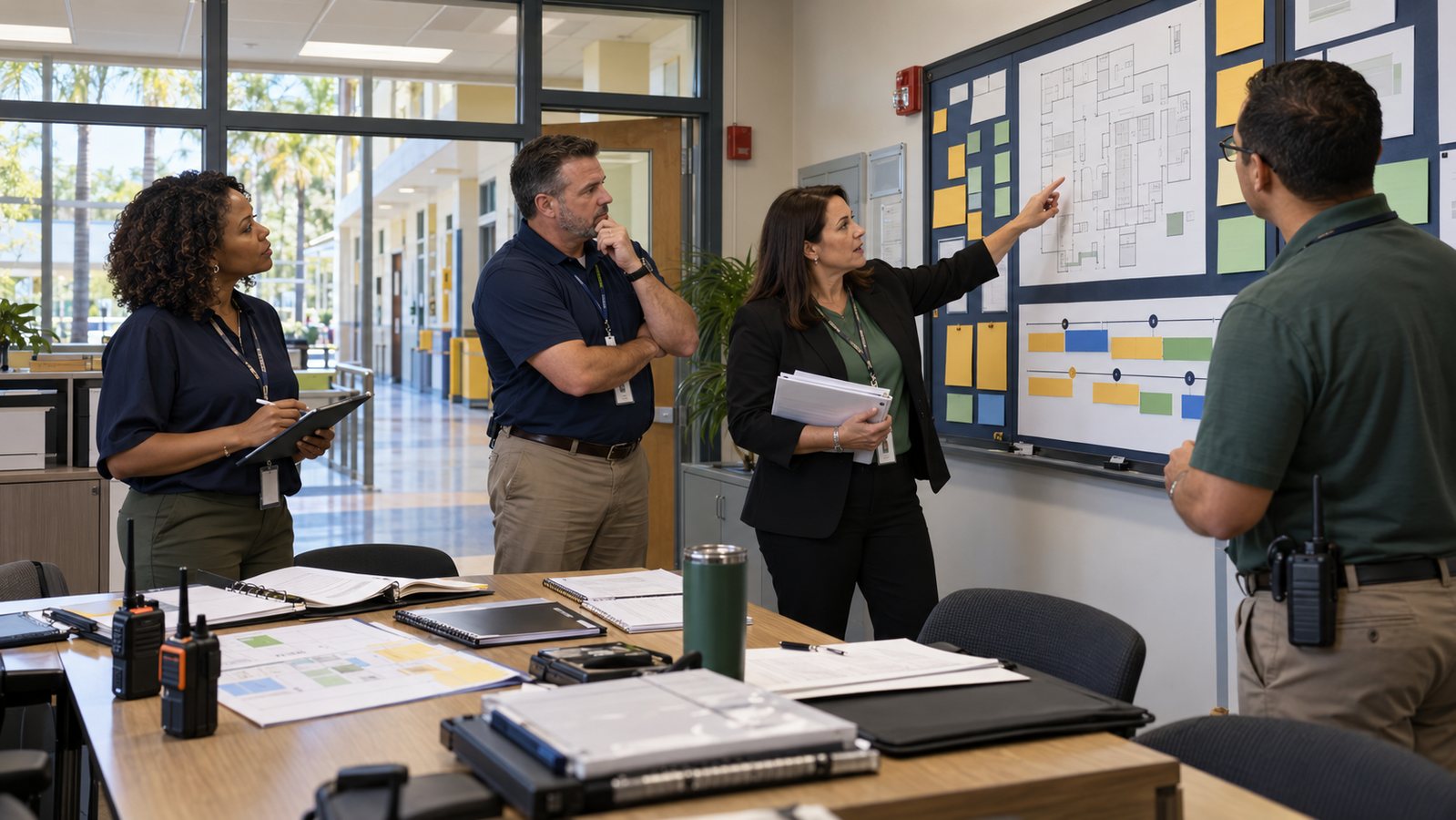
Why a cyber annex belongs in school emergency planning
Cyber incidents can interrupt attendance, communications, transportation, food service, payroll, classroom systems, student records, and access-control workflows. For a Central Florida school or district, a cyber event may also overlap with a hurricane, extended power outage, facility closure, or regional communications disruption. That makes cybersecurity an operational safety and continuity issue—not only an IT problem.
The U.S. Department of Education says K–12 organizations should integrate cybersecurity into emergency operations planning. Its October 2026 K–12 cybersecurity resource page highlights immediate measures such as patching, multifactor authentication, strong passwords, phishing awareness, information sharing, and incident reporting. The Department also points schools to a dedicated fact sheet on developing a cyber annex.
A cyber annex should explain how leaders coordinate people, decisions, communications, and continuity when technology cannot be trusted or used. It does not replace the technical incident-response plan. The two documents should reference each other, share roles and contact information, and be exercised together.
Define which operations must continue
Start with services rather than servers. List the school functions that must continue during the first four hours, the first school day, and several days of disruption. Examples include:
- Emergency communications with families, staff, and public-safety partners.
- Student accountability, attendance, release, and reunification.
- Health-office access to critical information and approved downtime records.
- Transportation routing and driver communications.
- Meal-service planning and point-of-sale contingencies.
- Building access, alarms, cameras, and visitor-management procedures.
- Payroll, purchasing, substitutes, and employee scheduling.
- Learning platforms, classroom materials, and special-education services.
For each function, identify the accountable leader, supporting staff, technology dependencies, approved offline method, maximum tolerable outage, and criteria for resuming normal operations. Avoid telling staff to move student or employee information into personal email, consumer file-sharing accounts, or unapproved messaging apps during an outage.
Establish activation levels
A suspicious email does not require the same response as district-wide ransomware. Define activation levels that leaders can understand.
A limited event may involve one account or device with no confirmed operational impact. A significant event may affect a shared service, expose sensitive data, or require coordinated communications. A critical event may disrupt multiple schools, compromise administrative control, threaten safety systems, or prevent essential services.
For each level, define who may activate the annex, who leads the incident, when senior leadership and legal counsel are notified, and when the emergency operations structure is used. Staff should know how to report concerns through a channel that remains available if email or the help desk is unavailable.
Separate facts, decisions, and public communication
Early information will be incomplete. Maintain an incident log that records timestamps, confirmed observations, decisions, owners, and open questions. Do not label an event as ransomware, a data breach, or a particular actor’s work until evidence supports the statement.
Name a communications lead and pre-identify alternates. Prepare templates for operational notices, but require case-specific review before release. Messages should state what is known, what is being done, what families or staff should do, and when the next update will come. Avoid technical speculation, victim blaming, or assurances that exceed the evidence.
The annex should also define who evaluates legal, contractual, insurance, law-enforcement, and regulatory notifications. Reporting to one organization does not automatically satisfy every obligation. The Department of Education directs schools to report cyber incidents to CISA and cybercriminal activity to the FBI; the correct notification path depends on the facts and the organization’s responsibilities.
Protect student data during response
Student information may be exposed through compromised accounts, vendor platforms, lost devices, malicious forwarding rules, or poorly controlled response activities. The Department of Education’s Student Privacy Policy Office emphasizes safeguarding education records and notes that breaches can contribute to identity theft, fraud, and extortion.
During response, limit access to those who need it, use trusted devices and accounts, preserve relevant logs, and document any temporary exception. Share sensitive records only through approved methods. If outside responders are involved, confirm confidentiality, data handling, retention, subcontractor access, and secure deletion in writing.
Plan for technology and vendor dependencies
Create an appendix listing critical platforms, business owners, technical administrators, vendor emergency contacts, contract identifiers, data types, authentication methods, recovery commitments, and known dependencies. Include identity providers, email, student-information systems, learning platforms, transportation, payment, physical-security, backup, telecommunications, and managed-service providers.
Do not assume a cloud service eliminates the need for recovery planning. Confirm what the provider restores, what the district must restore, how long recovery may take, and whether compromised administrator credentials could affect retained copies. Maintain protected, offline contact information and recovery instructions.
Coordinate with physical emergency procedures
A technology outage can change how doors, cameras, phones, public-address systems, visitor screening, and reunification operate. The cyber annex should identify which physical procedures become necessary when digital tools fail, but it should not publish sensitive floor plans, alarm details, or security-control locations in broadly distributed copies.
Central Florida schools should test a combined scenario: a cyber incident during severe weather or a facility closure. Confirm that emergency contacts, staff rosters, family-notification methods, transportation procedures, and essential records remain available when the primary campus and network are both unavailable.
Exercise the annex
CISA recommends written incident-response plans with defined roles and regular exercises. Run a tabletop exercise involving school leadership, IT, communications, student services, facilities, transportation, legal counsel, and relevant vendors. Use a realistic sequence: unavailable email, a disabled student-information system, an unverified extortion claim, and a family communication deadline.
After the exercise, record decisions that were unclear, inaccessible contacts, missing authority, unsafe workarounds, and untested restoration assumptions. Assign owners and deadlines. Then verify at least one technical recovery step, such as restoring a representative dataset into an isolated environment or using an emergency administrator account from a trusted device.
A practical annex outline
A concise cyber annex can contain:
1. Purpose, scope, assumptions, and relationship to other plans.
2. Activation levels and leadership authority.
3. Roles, alternates, and protected contact lists.
4. Reporting, triage, and incident-log procedures.
5. Continuity methods for essential school services.
6. Communications and approval procedures.
7. Student-data and evidence-handling safeguards.
8. Vendor, insurance, legal, and agency coordination.
9. Recovery gates and return-to-service decisions.
10. Training, exercises, corrective actions, and review dates.
The strongest annex is not the longest. It is the one staff can find, understand, and use when ordinary systems are unavailable. School leaders should approve it, responsible teams should rehearse it, and the district should update it after exercises, incidents, major technology changes, or changes in legal and contractual requirements.
Human-reviewed draft. This article provides general operational guidance and is not legal, regulatory, educational-policy, or incident-response advice.